
Dear <<First Name>>,
A young manager leading a team of senior employees. An experienced leader managing a team of freshers. Same company, very different stories and our research shows exactly why? Leadership is often seen as one-size-fits-all, but the real story is much more complex—and fascinating.
We analysed employee feedback ratings on their managers’ behaviours across multiple organisations, examining how leadership behaviors resonate with employees of varying career stages. Instead of simply focusing on averages, we analyzed how employees experienced leadership in different contexts—unveiling subtle but powerful insights.
Here’s what we discovered:
Manager Effectiveness: It’s About the Interaction
It turns out that leadership is a dynamic interplay between the manager and their team, not just the leader alone. The same manager may be perceived differently based on the career stage of the team they lead. A leadership style that works well for one team may not work for another, depending on where they are in their careers. This has portfolio implications for manager–team combinations.
Young Teams Love Collaboration, But Need Balance
For early-career employees, collaboration was a standout leadership behavior. In fact, they were 1.27X more likely to report strong collaboration experiences. However, they were also 1.22X more likely to feel their workload wasn’t well-balanced.
This indicates that while young teams thrive in collaborative settings, they require stronger guidance on prioritization and workload management.
Experienced Teams Crave Stability, But May Collaborate Less
When we look at more experienced teams, leadership expectations shift. These teams were 1.16X more likely to report strong experiences with balanced work. But they’re also 1.29X more likely to report weaker collaboration. Basically, the more experienced someone gets, the more they prefer working independently and having a steady, predictable routine rather than the buzz of constant teamwork.
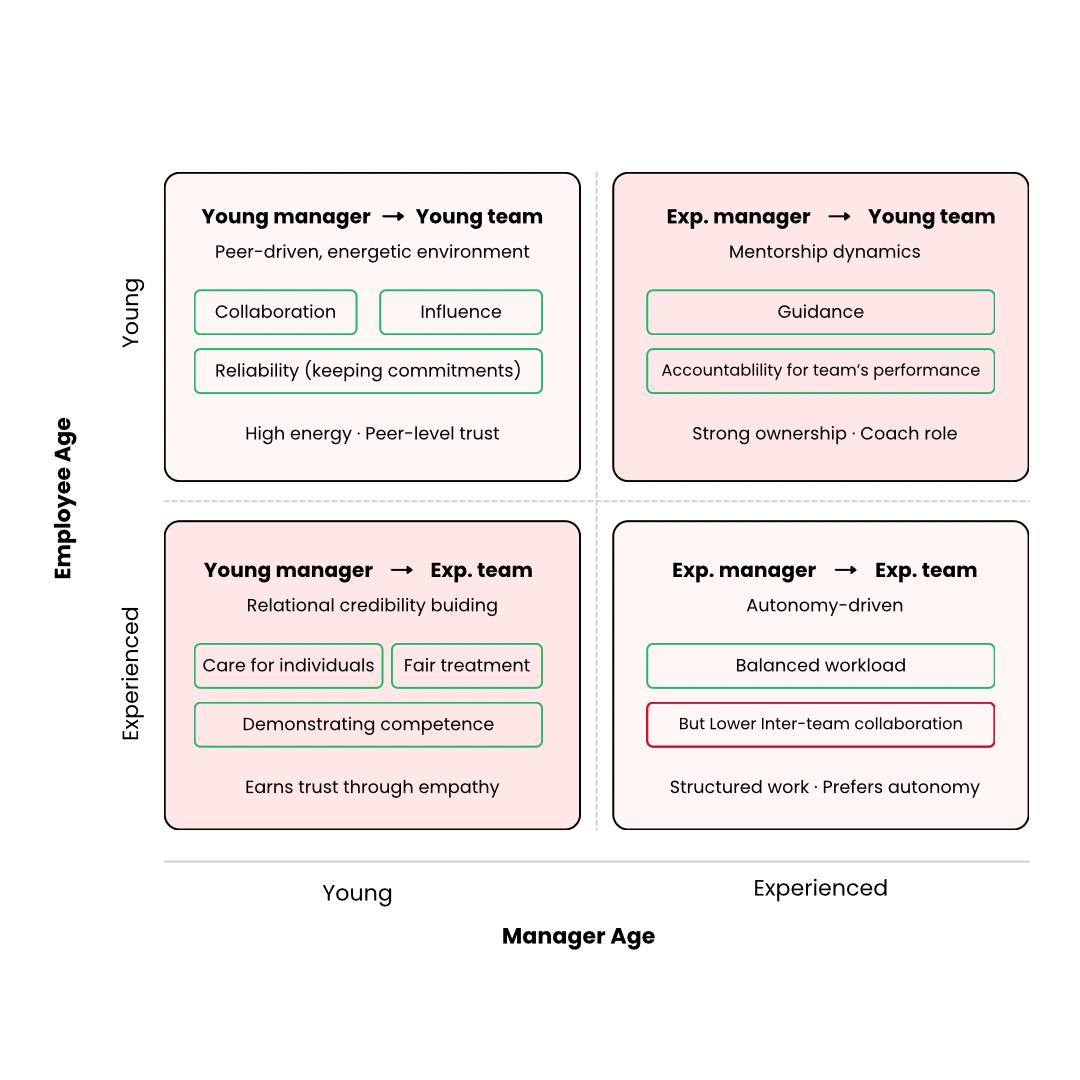
The Key Insight: Leadership Dynamics Vary by Manager-Team Combo
When we analyzed the manager–team age group combinations, four distinct leadership dynamics emerged:
- Experienced Manager → Young Team: Managers are perceived to be better in Guidance and Taking accountability for the Team’s performance (including mistakes made by the team), reflecting mentorship dynamics.
- Young Manager → Young Team: Teams report enhanced Collaboration, Influence, and Reliability (keeping commitments made), showing a peer-driven, energetic environment.
- Young Manager → Experienced Team: Teams experience higher Care for Individuals, Fair Treatment, and demonstrating Competence, where younger leaders build credibility through relational leadership.
- Experienced Manager → Experienced Team: Experience of the team is better on Balanced Work, but weaker Inter-team Collaboration, perhaps showing better ability in organising work and a distinct preference for autonomy.
Why It Matters
Leadership isn’t a one-size-fits-all concept. Each manager-team combination reveals a unique set of leadership strengths—from mentorship and collaboration to empathy and stability. Understanding these dynamics can empower organizations to match leadership styles with team maturity, ensuring more effective leadership and improved outcomes.
At Great Manager Institute®, we’re committed to helping organizations navigate these leadership challenges and align leadership styles with team needs.
Congratulations to the managers at Tata Starbucks for earning the Great Managers to Work With® recognition, which reflects their exceptional leadership and the impact they’ve had on their teams.