
Mandar, Author at Great Manager Institute® - Page 6 of 7

Last 50 days to participate in the Great People Manager Study®—be among India’s Top Great People Managers™. Participate now.

Choosing the Best Survey for Your Organisation

Scenario 1

Organisation ABC measures its employee satisfaction and morale annually through its traditional survey which is detailed, lengthy and outdated. After conducting the survey, it takes a couple of months to analyse the feedback and less time to take informed decisions.

Scenario 2

Organisation XYZ conducts 3- 4 surveys to measure employee satisfaction and morale regularly. These surveys are focused, short and are reviewed for their relevance before the launch. The responses for all the surveys are collated easily and analysed to take informed decisions quickly.

Have you spotted any of the aforementioned trends in your organisation? According to you, which organisation practices more efficient feedback mechanism that will lead to better employee engagement and satisfaction?

It is a basic human tendency to feel heard and valued. Within the organisational setup, employees feel engaged, motivated and inspired to contribute when their views and opinions are gathered and given due regard. However, when this need is jeopardized, organisations face adverse outcomes like non-performance, low employee motivation and higher attrition rates.  Employee engagement remains a top priority for HR leaders in 2023 across the globe, mainly because of the rising attrition rates and also engagement is largely intangible and difficult to measure. Therefore, organisations often resort to detailed employee engagement surveys to gather insights.

Surveys are safe and an easy way to gather feedback from a large pool of employees at once. Surveys provide a comprehensive platform for employees to share their thoughts, opinions, and experiences. This feedback helps organisations gain valuable insights into employee satisfaction, engagement levels, workplace culture, and other areas of improvement. Surveys also provide the option of giving answers anonymously, making the entire process more inclusive and safer for employees who wish to remain unidentified.

Despite the significance of surveys within the organisational setup, the frequency of conducting these surveys however remain a challenge for many organisations.  Research supports that the insights gathered every two year or annually are not sufficient to present a reliable and holistic picture of the status of employee engagement. Though many organisations are still relying on annual surveys to gather employee perspectives, many smart organisations are replacing traditional, yearly surveys with more frequent, real-time or pulse surveys. Such surveys apart for collecting real time insights, enables an agile and data-driven approach to employee engagement, making it look more lucrative for employees as well as for HR leaders, the real custodian of the process. Real-time surveys further allow you to maintain organisation’s health and happiness with rapid and more frequent check-ins. Let’s take a closer look at some of the benefits of using real-time surveys over annual surveys:

Ability to capture comprehensive, real-time information

While annual surveys only capture a snapshot from that particular moment in time, frequent pulse surveys offer a more detailed and accurate view of employee engagement and other aspects as it changes and evolves over a period of time.

Breaking the chain of monotony

Since annual surveys are conducted just once, they are mostly long and arduous. But in this process, surveys become lengthy with never-ending questions around various aspects of workplace. Employees do not feel enthused about giving their response and want to get back to work. This may lead to inconsistency in capturing their accurate response, impacting the overall validity of your results. Real time surveys on the other hand are relatively shorter with fresh themes and different set of questions which generate interest among employees and thus response rate gets better. Real time surveys barely impact employee’s commitments as they only take couple of minutes to answer. This improves the validity of results as respondents are more likely to give each question their full attention.

More efficient and data-driven post-survey analyses

Traditional annual surveys being comprehensive in nature, may ask each employee over 50 questions. Once conducted, it takes good amount of time to gather the responses, review the same and analyse it. This cumbersome approach takes months to plan for some organised plan and action making employees as well as other key stakeholders lose interest in the process.

Proactive approach

Annual surveys being a yearly affair, mostly collects data in retrospect while frequent real time surveys, highlight areas of concern before these problems escalate and become widespread issues within the organization. Realtime data about employees will empower HR leaders as well as managers to be proactive and invest time and effort in the areas where it’s most needed.

Creating a culture of inclusivity and feedback

Pulse surveys because of their higher frequency, naturally creates a culture of feedback and continuous improvement. People feel heard and more valued at work when they have a platform for giving feedback on a constant basis.

A word of caution for HR leaders

Well-made and well-administered surveys will remain an integral part of organizations mainly because of their ability to fetch response from a large sample. Organizations are exploring newer ways to run surveys and relying on HR tech to make the entire process smoother and streamlined. However, HR leaders need to be cautious of that fact that employees shouldn’t feel any ‘survey fatigue’ especially with real-time surveys which may be sent out too often, and/or the same questions being asked repeatedly; employees might get bored and may choose not to respond. Therefore, HR leaders must closely monitor the survey fatigue while conducting pulse surveys. Balancing the right number of questions with the right frequency is one of the most important aspects of conducting effective pulse surveys.

Conclusion

Both tools might prove beneficial when administered efficiently to gather employee feedback and sentiments, however, HR leaders in their pursuit to establish a continuous channel of communication between employees and organizations will rely more on the real-time surveys in the years to come. These surveys can be made more specific to uncover different aspects which may be short-term in nature, for example, a quick pulse survey can be created and run to gauge employees’ reactions about the latest merger and acquisition that happened. This will provide instant feedback from the workforce. HR leaders may also look at the judicious mix of both the tools to derive greater benefits; the annual comprehensive survey juxtaposed with 2-3 pulse surveys will immensely help to present a holistic view of the employee’s perceptions about their workplace.


Improving Employee Experience Using HR Tech

Employee experience has an immense impact on a company’s performance and growth. An enjoyable employee experience increases employee engagement, productivity, and overall satisfaction. Employees are more inclined to go above and beyond their obligations when they feel respected, supported, and empowered in their jobs, contributing to enhanced company performance. Companies that prioritise employee experience have the required leverage to recruit and retain top people which leads to lower turnover rates, and a healthier business culture that fosters innovation and success. Investing in employee experience benefits the company’s overall productivity and long-term profitability.

Streamlining Communication And Collaboration

Having a centralised platform for all of HR’s functions enables them to do their job faster and better so they can focus more on employee delight rather than grunt work.The end goal for this is for employees to be able to easily communicate with HR departments, ask questions, and seek assistance, thereby eliminating bureaucratic hurdles. Furthermore, collaboration tools allow teams to work together in real time, share files, and work on projects regardless of their physical location. Organisations have the ability to build a more inclusive and connected work environment by employing HR tech solutions for communication and collaboration, breaking down silos and encouraging a feeling of teamwork among employees.

Rewards and Recognition

A strong rewards and recognition program is the core of organisational employee engagement. R and R has evolved into a metric of excellency for workplaces to satisfy evolving employee requirements. HR technology may assist organisations in establishing and managing R&R programs to improve employee morale, motivation, and engagement. These tools enable the automation of reward programs, which provides managers with real-time visibility into employee performance and contributions. This also allows for the customization of incentives and recognition programs to correspond with the particular requirements and preferences of workers, hence increasing engagement and satisfaction. The analytics capabilities built into HR tech platforms allow firms to gain insights into the performance of their rewards and recognition campaigns. This enables data-driven decision-making and continual development. Organisations can build a culture of appreciation, raise employee morale, and ultimately push performance and retention levels to new heights by using HR technology

Flexible Benefits

Benefits are often a deciding factor for employees when they are comparing jobs, according to this Harvard Business Review Study. Making your company’s benefits as appealing and as customisable is in your favour if your goal is to retain and nurture top talent. According to the same study 83% of employees would rather have additional benefits than a pay raise. All of this points to the importance of flexible benefits. Technology enables businesses to establish a well-thought-out flexible benefits package that gives employees a choice of perks. An HR technology platform can also assist businesses in tailoring flexible benefit plans to specific employees, resulting in a more personalised experience that encourages loyalty and performance. 

Simplifying Onboarding and Enhancing Training Processes

Effective onboarding and training are critical for ensuring that new employees are able to comfortably adapt to their responsibilities and contribute effectively to the business. HR technology can help you streamline these procedures by providing new solutions that simplify and improve the onboarding and training experience. Digital platforms serve as a consolidated repository for onboarding materials such as digital forms, policy paperwork, and training resources which removes the need for time-consuming paperwork and manual processes. HR technology solutions also allow for the development of interactive and engaging training modules that incorporate multimedia components, simulations, and evaluations to encourage a dynamic learning experience. As a result, the workforce is more engaged, confident, and productive, positioning itself for long-term success. 

Leadership Assessment and Development

Organizations should use HR technology solutions to implement complete assessment frameworks that analyze leadership potential, competencies, and behavioral attributes. We can use a variety of tools and evaluation approaches, like psychometric testing, 360-degree feedback, and simulations, to create a comprehensive picture of a person’s leadership competencies. The information helps firms to identify high-potential employees and make tailored development plans to help them improve their leadership abilities. HR digital platforms also include a variety of learning tools, like online courses, coaching modules, and virtual leadership programs, that can be adapted to the unique requirements of prospective leaders.

Leveraging Data Analytics for Decision-Making

Data analytics has become an indispensable tool for making informed decisions, and HR technology is no different. It has the ability to improve employee experience by collecting, analysing, and visualising vast amounts of employee data, ranging from performance metrics and engagement surveys to feedback and sentiment analysis. As an example of how this is helpful, analytics can reveal patterns in employee turnover, which helps organisations identify underlying causes and develop retention strategies based on that data. Similarly, sentiment analysis of employee feedback can tell management about areas where improvements are needed, allowing HR departments to address pain points and improve the overall employee experience.

HR technology offers significant benefits for improving employee experience. Streamlining communication and collaboration, implementing rewards and recognition programs, providing flexible benefits, simplifying onboarding and training, assessing and developing leadership potential, and leveraging data analytics all contribute to enhancing employee satisfaction, engagement, and productivity. By investing in HR tech, organizations can create a more connected and efficient work environment, attract and retain top talent, and make data-driven decisions that improve overall employee experience, leading to long-term success for the company. 

The Power of L&D Leaders over Organisational Culture

Organisational culture, refers to the values, attitudes, beliefs and behaviours that shape up organisation’s unique social and emotional work environment. A culture is ‘exclusive’ for every organisation and it is often said that the culture is nothing but the consistent, observable patterns of behaviour in organisations. It is mostly governed by the leaders of the organisation to be only followed by the employees.

A great organisational culture is the key to achieving business success. Research supports that organisations with ‘healthy cultures’ are 1.5 times more likely to experience higher revenue growth and productivity. Despite this, only 31 percent of HR leaders believe their organisations have the culture they need to drive future business. Sadly— 85 percent of organizations fail in transforming their cultures. Some of the reasons of this failure include- lack of robust business and L&D strategy, unclear values, incompetent leadership and employees’ dissonance with the organisational values and beliefs. Recent research cites ‘toxic organizational culture’ as number 1 reason of employees leaving their organisations.

How employees think and feel about their workplace and its culture is critical to competitive advantage and sustained organisational success. The importance of culture is especially elevated in recent time when the phenomena like ‘The Great Resignation’ as well as ‘Great Firing’ are prevalent. The millennials and Gen z’s at the workplace have their own ways and seek continuous growth and learning to make an impact. Managing such individuality and diversity in the workforce further raises the need to have more streamlined Learning and Development (L&D) practices and efficient leadership skills to build strong and resilient organizational culture. L&D leaders can play a pivotal role here! In addition, if we look at the future trends, studies report that automation may displace 85 million jobs by 2025- this will greatly alter the workforce dynamics as well as skill sets needed to perform the tasks. Many businesses as well as L&D leaders are mindful of this need to upskill and reskill the workforce and understand that learning will no longer remain only a retention measurement but will be a key in realising business strategy.

It is often believed that L&D function is only associated with conducting programs and training for enhancing the skill sets of the employees. But this function has a very big role to play in shaping up the organisation culture by influencing the top leadership and their business strategy.  L&D leaders today influence all parts of an organisation, across job levels, functions and business units, from new hires to senior leadership and everyone in between. By weaving organisation’s purpose and values into every aspect of learning, L&D leaders can become ‘Cultural Ambassadors’. Let’s delve deeper into the ways L&D leaders can shape culture:

Align L&D with the organization’s goals and values

By aligning L&D programs with the organization’s goals and values, L&D leaders can help promote a culture of accountability and a shared sense of purpose. This alignment can commence as early as the induction process where employees are given good overview of the organization, its values, processes, practices and expectations. L&D leaders must be cognizant of the cultural signals they are sending through a new employee’s early learning experience and ensuring alignment with the core organizational values.

Relevant training programs

L&D leaders are responsible for developing and implementing training programs and initiatives that are essential for the professional growth and development of the employees. These programs should be crafted in sync with organizational culture, for example, R&D heavy organizations may conduct programs which encourage innovation and experimentation, instilling values such as risk taking, learning from failure and continuous improvement. Similarly, if an organization values diversity and inclusion, L&D leaders can design training programs that focus on those topics, making it clear that these are essential elements of the organizational culture. Effective L&D programs can lead to increased employee engagement, retention and performance. When L&D leaders create a culture of learning, it can impact the overall organizational culture positively. When employees are encouraged to learn and grow, they feel valued and it creates a sense of community within the workplace.

Promote knowledge sharing

Learning and development leaders can facilitate knowledge sharing by creating opportunities for employees to learn from one another, share best practices, and collaborate on projects. They may set up relevant workshops and open sessions where employees feel free to exchange ideas and suggestions

Lead by example

L&D leaders should lead by example, demonstrating a commitment to their own development and modelling the behaviours they want to see in others. At the same time, L&D leaders need to involve other key stakeholders in their initiatives so that everyone remains on the same page and demonstrate core values and persistent behaviours.

Measure the impact of learning and development

By measuring the impact of L&D initiatives, the leaders can demonstrate the value of continuous learning and development and reinforce its importance to the organization culture.

Organizational culture is the backbone of any successful organization and without it, no organization can survive for long.  L&D leaders can play a significant role in building strong organisational culture by linking and aligning organisation’s vision and values with employee learning programs and practices. A strong and positive culture is directly linked with employee engagement, happiness, productivity, and retention. L&D leaders should direct their every effort toward achieving these outcomes. At the same time, they also need to upskill themselves and grow their own cultural intelligence to come up with the best learning initiatives.

To know more about how our leadership assessment and development platform can help your L&D leaders create a organisational culture that drives sustained business results, click here.

What your people managers must do differently during appraisals?

For many organizations, conducting performance appraisals, or having what some are now calling “performance conversations”, elicits a sense of dread in both the people managers and the employees. The good news is, there are ways to create a valuable forward-looking discussion that improves engagement, retention, and shapes culture. Consider the process on two levels; the macro-level, which involves the company-wide process and structures that support people managers, and the micro-level, which involves managers having a baseline understanding of how to deliver and receive feedback during these conversations as well as throughout the year.  

The process and structures that support performance conversations matter. Commonly, organizations will create an appraisal template to be completed with some instructions and a calendar for finishing the reviews, and that is the extent of it. While you don’t want to over-engineer the process, to make the outcome a thoughtful and motivating one, consider the following:

Is the objective of the process clear and easy to articulate? For example, is the objective to provide employees with feedback about past performance, discuss ongoing development, and gather insights about the employee’s experiences during the performance period? This sounds familiar and probably standard practice for most companies, yet does it drive improved performance, or does it lessen the anxiety managers and employees feel when the time comes to prepare. Is the process used to determine changes in compensation? In either case, that should be made clear.

Since feedback, positive and negative, should be given to employees in real time and not saved for an annual conversation, there shouldn’t be a gap between what the employee believes they will hear and what the manager delivers; does your process test for this? Some companies are rethinking their objectives, and some are scrapping the process altogether, in favor of  alternative approaches to creating ongoing bi-directional feedback. However, with clear objectives and the structures in place to support the process, there is still an opportunity to make these conversations more valuable for everyone. 

Perhaps a more forward-looking and engaging objective would be stated this way, “we want to continually enhance individual, team, leadership, and company performance and as one part of that, we think it is important to invest time (add frequency here) to exchange and align on feedback, set SMART goals (specific, measurable, achievable, realistic, and timely), explore career development opportunities, and revisit compensation.” This language introduces a more bi-directional tone and establishes individual performance as only one aspect of organizational performance; it also frames the effort as an investment, rather than an obligatory exercise.

What is the right cadence for a performance conversation? There are schools of thought suggesting the more frequent the better, however if managers are giving constructive feedback in real-time, a more career development-oriented conversation can be effective — not rushed — when done annually. One of the reasons managers struggle with the process is because many companies have made it a “time-of-year” exercise so when leaders have a substantial number of direct reports the whole thing turns into an onerous project tied to a calendar of deadlines. Not only do they have to anticipate some difficult conversations, but they also must put other priorities aside and try to invest thoughtful time into preparing and having the conversations. What usually ends up happening is documents are copied from prior appraisals and modified; all sorts of cutting and pasting is done to save time. Discussion meetings (appraisals/reviews) are cut into shorter lengths of time to make sure deadlines are met. If the reason behind a “time-of-year” process is to align compensation changes with budget or financial reporting periods, consider uncoupling the two. Let managers spread out these discussions over the course of the year by employee anniversary date or other methods. By having fewer discussions more frequently, the process isn’t overwhelming, and managers are continually practicing their tradecraft. 

Do managers and employees have the information they need? Whatever your stated objectives are, make sure managers and employees have the information they need to make the conversation a constructive and non-subjective one. For example, if continual improvement of team performance is part of your objective, managers and employees should have access to the targets and actual team performance on key performance metrics. This allows for an informed and transparent discussion where managers can gain insights into what the employee thinks contributed to achieving the targets… or missing them. Another example might be organizations that want to collect feedback from other collaborators, such as project stakeholders, peers, direct reports, matrixed reporting relationships, and more. There are plenty of inexpensive tools for collecting “360-degree feedback” so if this is an important component of your process, allow time to complete the step and give employees time to review the feedback before the meeting. The more transparent, the less overall anxiety and more trusting the culture.

Are your people managers trained on preparing and holding these meetings in support of the stated objectives? This is where the macro-level structure is married to the micro-level conversations. Consider what every people manager in your organization needs to know and make it part of onboarding with regular opportunities for refresher training. Here are some recommended items for the curriculum: 

  • Understand the Objectives 
  • How to Prepare
  • Real Time Feedback and Aligning Perception
  • Important Data
  • Active Listening
  • Setting SMART Goals
  • Language, Dos and Don’ts
  • Setting Expectations
  • Creating a Career Development Plan

Again, the intention with this training is to make sure the conversations are engaging, and something everyone can look forward to. You may want to include a self-appraisal for employees to complete and share before the scheduled conversation so managers can compare what they have prepared to the perception of their employee. When there are misalignments, it may mean the manager isn’t providing timely feedback, or not communicating that feedback effectively. Training on how to test for this alignment and how to reset expectations during the conversation is important and an area of opportunity for many new managers. Also, understanding what language triggers negative emotions rather than a constructive conversation is not intuitive to all managers so ongoing training to reinforce the “dos and don’ts” can make a big difference. Finally, give managers a chance to practice these skills by investing time for them to meet with each other and role play the conversations; it can be a lot of fun and leaders benefit when learning from each other.

If annual performance conversations have become an unwelcome interruption to your already fast-paced work environment it is something you can change. Don’t be afraid to apply the same innovative thinking you use to shape your products and services. Build something your employees will boast about when they are telling their friends and family what it is like to work at your company. You may just find it becomes a competitive advantage.

Ensuring Efficiency in a Dynamic Age

The last two years, 2020 to 2022, prove how uncertain and unstable life can get. The outbreak of Coronavirus in March 2020 forced all institutions/ organisations to shift from in-office work to working from home till vaccines were made available to the Indian population in January 2021. James Thomas, a partner with Strategy&, a global think tank focused on culture, behaviour and leadership change, in his article, ‘How the pandemic has changed workplace culture for the better. He talks about the rapid shift from in-office to working from home to back to in-office work. He highlights the problems in this rapidity and the abandonment of working in-office. While modern collaborative technology has made working safe and easy, it has reduced human interaction. We come across a struggle in building trust and rapport, a gap in the mindset of leaders and employees, and anxieties and hesitation among employees at all levels. How can a leader  address certain anxieties and ensure efficiency at the same time?

The simplest way to do so is to lead by example by managers being present in the office, just being there shows effort. Thomas talks about how face-to-face interactions are necessary for building trust. It makes it easier for managers and employees to gauge social, and non-verbal cues. It helps in understanding that which the person in front might not say explicitly. Being present demonstrates a commitment by employees and leadership alike.

Another crucial step in ensuring efficiency is developing a solid two-way line of communication. Leaders, managers and internal communications professionals have an extremely important role in keeping employees connected and engaged. The impact of the pandemic has taken a significant toll on employees’ personal, social, and professional lives. Overwhelming fears around health, safety and job uncertainty are continuously leading to anxiety, frustration, and low employee morale.

 While leaders can and must provide context and guidance at the beginning of a project, employees too must make an effort to convey their doubts or any kind of reservations they may have. Leaders are required to check in more and learn ways to support their employees in moving forward.  This can be done by giving them the space to take ownership of their jobs and allowing them to complete their work how they think is best. Leaders can also communicate the importance of discipline and boundaries. This is crucial for organisations or companies that are functioning in the hybrid mode. People working from home tend to get less productive over time, they lose their frame of reference and task orientation, and the boundaries between working and signing off become blurred and they can’t ‘switch off’ or ‘log out’. Here is when leaders can step in and create distinctions between the time to work and the time to rest. Organisations need to lay particular emphasis on restoring employees’ emotions and trust, to maintain productivity and employee engagement. Support from the managers, leadership, HR, and internal communications, are some of the prerequisites for ensuring employees’ productivity and business success. 

An article written by Kristina Martic on ‘How to Ensure Productivity in the  Post-Pandemic World’ emphasises the apparent importance of focusing on your employees’ physical and mental health, she also talks about businesses building a continuity plan. It is believed that employees function and perform well when they feel secure and their productivity depends on how well a company or a business is prepared to deal with a similar crisis. Business Continuity Plans are crucial because without a plan a workplace will not have a clear sense of how to return to business as usual.

Leaders must develop an overall workforce strategy and action plan that puts people first. Which further requires a strategy around how to best deliver and communicate it to your employees. Again, effective communication is key to making a recovery faster, protecting company assets and minimising losses.

Employees’ productivity and overall performance have been disrupted by the pandemic and by cultural and social challenges linked to the current tendency of working in the hybrid mode or a socially distanced set-up.  How leaders, managers and organisations as a whole support their employees and help them to stay connected has a major impact on company culture and employee experience. Employees need to be given an easy way to communicate and collaborate with their peers and managers. Leaders and internal communications professionals have to be the ones leading the transformation towards more open and transparent workplaces to boost employee productivity and success.

As trust and transparency in the workplace are some of the most in-demand traits employees are looking for in their employers, they not only influence employee productivity but also enable employers to attract and retain talent in their organisation. A study conducted by Great Place to Work shows that when millennials work in a high-trust culture they are 22x more likely to in their company long term.

Living in uncertain times leads to confusion in all areas of life, particularly in the workplace, we see a lack of clarity which ultimately leads to failure and not only a loss to the company or organisation but also to an employee or team’s confidence/morale. Therefore, it is important to set clear targets and expectations beforehand. Setting clear goals fuels employees’ productivity, commitment and motivation, providing the freedom for them to act independently within the defined boundaries. 

Managing or leading is a tedious task that becomes tougher when your team works from different locations. Jennifer Robinson’s work ‘Covid-19 Has My Team Working Remotely: A Guide For Leaders” stresses the importance of enhanced leadership and manager communications. She talks about leaders allowing managers to guide and handle their teams in their way. She suggests the formation of individual professional relationships. Such practices help managers know their employees’ strengths and weaknesses. Managers must also be sensitive and aware of certain mental health issues which snowball into disorders if we are not careful. For example disorders such as Generalised anxiety disorder and Depression. These disorders are sadly rampant in our society and are often ignored, they manifest in different ways and at times have devastating consequences to the psyche of a person.

Managers/leaders or any person dealing with people or is just in a line of work that requires them to interact with people must make the effort to educate themselves on what such issues are and how they manifest in our daily life. Disorders like anxiety and depression at times manifest themselves in the form of physical symptoms like a headache, sweating, or when a person constantly shakes their leg etc and an extreme manifestation of anxiety takes place in the form of panic attacks which occur can occur without a trigger as well. While disorders like depression go unnoticed because of how normalised their presence and effects have become. We also come across something known as High-functioning mental illnesses, it basically is that a person may be leading a ‘normal’ life, they study, have a job, friends etc but what goes inside their mind, the war and panic they fight every second goes undetected simply because they don’t display the typical features of being ill. Mental health/disorders sensitisation has become all the more important after the outbreak of Coronavirus. Understanding, becoming sensitive towards and addressing such issues is of utmost importance to everyone working under/for a company. Companies must ensure that there are provisions for employees that help them deal with such issues. Provisions can be made in the form of breaks, taking/giving employees a day off, employing educated, sensitive mental health professionals or ensuring that members of your Human Resource team are well aware and sensitive, time must be taken out to address issues that can be life-threatening, and should be destigmatised. Only then employees will know that they are seen as human beings and are understood and then they will perform efficiently even in troubled times.

Dunning Kruger Effect: Why managerial effectiveness in India is broken

Unless you are a mentalist and can read people’s minds, it is likely that you rely on your perceptions – when it comes to understanding what people think about you. This is true for me, you, and almost everyone.

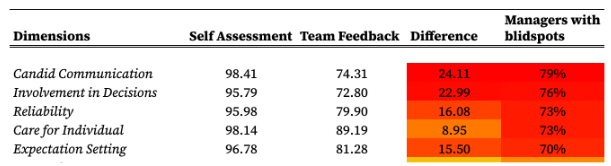
Research conducted by Great Manager Institute with 4,296 Indian managers, over the last 6 months reveals that unfortunately these perceptions that managers carry, are largely INACCURATE. 

As a result, gaps exist between our self-perception and the team’s perception – the Dunning-Kruger effect. This effect suggests that we tend to overestimate our competence in areas where we lack information resulting in lack of managerial effectiveness in India.

I have some interesting data for you below:

We asked 4,296 Indian managers to rate themselves on their ability to:

Candid Communication (Giving straight answers to questions)
Involvement in Decisions (Taking the team’s opinion in work-related decisions)
Reliability (Keeping their promise)
Care (Moving from transactional to relational
Expectation Setting (Proving clarity on expectations)
…..and 12 more areas

And we were surprised.

More than 70% of the surveyed managers rated themselves way higher than what their team members experienced, in all the above areas.

Why?

An in-depth understanding of ANYTHING takes years of study and practice – formally or informally. I’m a management graduate and I have been trained to develop good marketing plans. 

However, I don’t recall learning about setting clear expectations, involving people in decisions, or any of the points mentioned above.

And that’s precisely why I was compelled to write this. 

Nobody wakes up in the morning, with the intent of being a “Bad Boss”. 

70% of managers don’t know that they aren’t managing effectively, and those who know may not be doing anything about it (the KNOWING-DOING GAP). This results in a lack of managerial effectiveness.

You can read the full report on leadership blindspots here.

In the end, we end up being a country where people are universally unhappy with managers.

Guide to Designing a good leadership development program

What is a leadership development program? It is a process that helps in expanding the capacity of individuals/employees. Developing a program or structure helps in the execution of an organization’s strategy. Leadership development is that which helps organizations harness the talent they already have and require for the future. The world is expanding and evolving and the workplace must adjust and adapt accordingly. Organizations don’t stay the same, making it all the more important for them to have leaders who can lead, manage change find new opportunities, and execute strategies irrespective of the circumstances. Our 5-step guide to designing a leadership development program will help you create a program to meet all your needs.

Leadership development programs are a way for organizations to invest in internal growth and train employees with higher potential to take on senior positions. But, what we think of as ‘good’ leadership qualities and skills associated with it have changed. The sooner organizations realize the importance of agility, the better leadership program they will be able to develop and implement.

In the process of developing a leadership program, the most important tool required is context. Organizations need to know the skills and the type of experiences they require or skills and experiences that are most relevant to the future of their organization. One needs to anticipate or consider what the future holds for them. What types of challenges is the company likely to face? What will be the key skills the company needs from its leaders moving forward? If the company plans to grow through acquisitions or they’re aiming to onboard new clients or partners, then sales and negotiation skills might be two areas to focus on in the program. 

Robert Half in his blog How to Create a Successful Leadership Development Program shares certain steps or activities an organisation can undertake to successfully create one. He starts by talking about getting familiar with what an organization lacks. Such a program should start by 

Defining a company’s leadership needs

The 1st step in our guide to designing a leadership development program is to start by looking for gaps in leadership. For example- if a manager or someone occupying a senior position is leaving or retiring, besides the position being vacant what other skill or attribute will you be missing out on?

Or set your program according to the goals you wish to achieve. Adjust it according to the company’s short-term or long-term strategic goals and develop your leaders accordingly.

Secondly, he talks about developing leaders and not training them. To develop someone means to make use of the talent or gift a person might have, to make it stronger and more effective. While training a person typically means, shaping them into a certain mould or training them to be or perform in a certain manner.

Develop, don’t train

Robert Half urges readers to remember that leaders can be developed and nurtured, they aren’t manufactured, and there isn’t one formula for making them. Hence, the need for personalised leadership development programs. When one is creating this, one should think about how a participant can be placed in a situation and how it will help them learn and grow.

Examples include giving candidates the opportunity to step up when other leaders are away or to collaborate with colleagues in other departments on a special project.

Formal Development Methods

Mentoring, training and organisational planning, with individual activities such as job rotation, job shadowing and project leadership make a leadership development program effective. Classroom training, such as MBA programs, and online courses might also be part of a formal program.  Providing support to participants through ongoing feedback and coaching can be helpful, especially when it comes from senior managers.

Identify Potential Leaders

Potential leaders may be anywhere in your company, but identifying them isn’t always easy.  One should be careful in using resources. Just because someone has demonstrated excellent work in his or her current position doesn’t mean that person will evolve into a leader for the business. Have an open mind, and be willing to look beyond the most obvious candidates.

An effective leadership development program should be able to polish all the “diamonds in the rough” in your organisation and give employees the skills and confidence to ascend the career ladder. Even if a person doesn’t take up the senior position or leadership role they’re being offered it’s alright, just make sure that all employees are aware of the leadership development opportunities available in an organisation and have an opportunity to take advantage of them.

Focus on Retention

While leadership development programs serve as long-term staffing strategies besides other benefits, one must also be careful to not lose certain valuable employees one has already scouted. This can be done by offering promising employees compensation to match their developing skills. One must consider holding regular face-to-face meetings with future leaders to ensure they’re satisfied with their career path and feel engaged. An employee rewards system, in which staff members earn incentives such as letters of appreciation from higher-ups for specific achievements long after the program has ended, can also positively impact retention.

Leadership Development programs are required to ensure that organizations always have capable people especially those who have been working with them for a longer period of time and are aware of the intricacies. It is also easier to grow or find leaders within your organization than to find others from outside. Such set-ups also bring about a boost in an organization’s bottom line. It makes sure that there are more people who understand the high-level strategy and are equipped to take on business challenges. 

Secondly, you’ll be saving on turnover costs. When employees know that management has made an investment in them and that they not only have opportunities to grow but that there are available roles to grow into, they are more likely to stay. 

Another factor that positively impacts company financials is increased productivity. Employees who feel nurtured and who can see a future for themselves at the company are much more likely to be engaged in their work, thereby motivating others toward increased productivity as well. 

Hope you found our 5-step guide to designing a leadership development program useful. You can also explore how our leadership assessment and development platform can be integrated into your leadership development program to help you build great leaders at scale.

5 Reasons why your company needs a real-time feedback

Many business leaders feel their company needs to shift to collecting real-time feedback. The discussion regarding the obsoleteness of the annual performance review system has intensified in the last few years. The uncertainty springing up from the pandemic, fluctuating markets and demands, and radical digitalization have made it crucial for any company to adapt and transform, keeping up with the pace of time. While the state of the world today is challenging every preconceived notion we have of predictability, companies are on the lookout for impactful structures and systems to deliver better results. Waiting for a good twelve months to suggest improvements or show appreciation does not seem like one of them.

The VUCA world today demands agility more than anything. Even though the term has become a popularly inseparable part of business conferences and discussions, when it comes to the groundwork, there is no grounding. It appears to linger in the air, solely in words. However, this is not the universal truth either. A lot of companies like Accenture have completely denounced the system of performance management review to adopt something called the Real-Time Feedback system. A system that caters to changing needs and times of the world of work.

What is Real-Time Feedback System anyway?

Remember how infuriating those times make you when your partner brings up a topic from months ago in an argument that you have no memory of? 

Precisely how resentment and helplessness build up annoyance in your employees too when check-ins are experienced long after the task is completed. In another case, there can be the hindrance of recency bias as well. This kind of bias refers to the neglect of the participation and work performed in the initial months of the financial year. It, unconsciously or consciously, derives an impression of someone and their work from the relatively recent time frame when the final review is being constructed.

Now that the failure of a long gap in work and feedback is identified, it will make it easier to gauge the importance of Real-Time Feedback. In extremely simple words, it means, delivering feedback instantaneously concerning the work at hand. This model of effective communication does not just take the form of a harbinger of healthy relationships amongst teammates but also helps in the progress of individuals eventually leading to better business results. To remove the lag between the time work is delivered and the time feedback is collected, every company needs a real-time feedback system in place.

Let’s break down the real-time significance of this real-timing of feedback

The Boomers are gone, why should the system stay?

The employee strength, now and in the coming time will be dominated by Millenials and Generation Z. For generations who esteem ethics and values of an organisation in high regard and, to say in the slang, “take no shit”, it is important for managers to buckle up to work with them. Additionally, these generations are also known for their demands for clarity and transparency. 

What one can derive from this psychological shift in employees is the need to emphasise the aspect of ‘instantaneousness’, whether in appreciation, recognition, or suggestions for improvement. Importantly, these generations are also highly up to the minute with learning and development owing to the quickly shifting nature of work and qualifications for a job position. Real-Time Feedback helps nurture the culture of learning in an organisation. 

Humans are ever-changing just like the times, the new-gen recognises it

The once-in-a-year celebratory nature of providing feedback to the employees is anything but positively fruitful for the new generation. The system of Real-Time feedback recognises it and presents itself as an opportunity to set up itself as an effective alternative. Humans are fickle but also ever-growing, ever-changing. 

Giving feedback for something that happened months ago is futile. The person has grown, changed and transformed. Henceforth, the best way to improve performance is to venerate this non-static nature of your employees and equip them with feedback exactly when the problem or extraordinaire surfaces.

Nothing can beat transparency and effectively saying it out loud in forging a healthy manager-employee relationship

Ambiguity, vagueness and not effectively communicating so as to ensure both parties are on the same page can easily make interactions between the two sour and salty. Sometimes, it is, in fact, unintentional. Both operate from a perspective that they have not identified and therefore, not verbalised to even themselves yet. The system of Real-Time Feedback counter-attacks this human tendency. It forces employees and managers to deliberately think and evaluate every emotion they might be experiencing with respect to the work done or given. It pushes them to be certain of their impression of the task or person at hand. 

Quipping each other with instant feedback as the identification process concludes helps the one at receiving end also instantly go through the suggestion and evaluate their position. As utopic as this sounds, effective communication can most definitely forge an extremely healthy manager-employee relationship. This, then, eventually leads to better performance as flaws and perfections are quickly laid down and space is given for introspection. 

If it had to be said in short, it boosts employee engagement given the constant communication and supply of motivation and will to do better with clarity.

Goodbyes to Panic and Anxiety

Especially after the pandemic, companies have begun to understand the vitality of taking care of their employees’ mental health along with that of physical. Various organizations launched projects to ensure that their workers were doing well. However, a much-neglected facet where panic and anxiety seem to become best friends of the employees is the day of review. The unknown haunts, whats, and hows about the once-in-a-long-while review from the manager might lead to sleepless nights too. 

To tackle this, every company needs a  Real-Time Feedback system. It eliminates these troublesome feelings. The consistency of feedback can help them mentally prepare for the project just executed, not a variety of it they performed over a long course of time. It will also help them not fret over where they stood all year or month long with respect to their OKRs (Objectives and Key Results) and KPIs (Key Performance Indicators). A regularity in closures and expectations expressed can clearly be a game-changer!

Let’s steer the way for the new ones to settle faster

Commonly, companies consider one month as a learning period for every new employee giving them space and time to settle in and understand the ins and outs of the work at hand. The challenge every manager deals with is how to reduce this learning period and make the new employee as productive as an older one with minimal guidance. If not, then, at least accelerate this process.

A revolutionary solution is Real-Time Feedback. The more consistently the person will be evaluated and communicated with the expectations concerning the results, the more clarity they will harbor. It will also help them understand the culture and proceedings of the team or organization faster than they themselves slowly observe. 

If it can be said, it just takes one change in the system for a tortoise to turn into a hare. And, in this story, the quick and steady wins the race!

Is a real-time feedback survey one of the pressing needs of your company? Know more about our leadership assessment and development platform that helps you incorporate real-time feedback surveys to measure the effectiveness of your people leaders. To schedule a demo, click here.

1 thing CEOs can do to achieve profitable growth – help managers bring employees’ personal best

“How can I achieve profitable growth?” is a question all CEOs are constantly asking themselves. It is fair to say that the likelihood of achieving optimal growth and profitability rises as a company’s workforce is performing at its personal and professional best and It is also true that your front-line managers can be positioned to accomplish just that. There are three parts to this winning equation; it starts by understanding what employees need to perform at their personal best. Next, you need to understand how this changes the expectations of a manager from perhaps what it is today. Finally, you have to be committed to training and empowering front-line managers to deliver on those needs.

Employees bring their best into the workplace and can help CEOs achieve profitable growth when these 5 important conditions exist.

Trust

Research shows that high-trust organizations perform better than their competitors. When employees trust the organization they work for, they are more likely to engage proactively in the work. For your employees, their managers are the face of the organization and are best suited to build that trust. Managers have to display transparency and authenticity in how they interact with their teams and as with any relationship, earn employee’s trust.

Belonging

People have an innate yearning to belong; they may satisfy that need many ways, be it a church, a book club, sports team, etc. When people feel they belong they commit themselves to whatever the mission of the organization is, and that includes their employer. While you don’t want the work environment to feel like a cult, you do want people to feel part of a team with shared goals and accomplishments. To the contrary, when people don’t feel they belong, they are more likely to search for other employment, or simply do the bare minimum they are required to do.

Balance

More than ever, workers want to better balance their work life and personal life and are seeking flexible schedules, remote or hybrid options, and even more casual attire when possible. While pay and benefits remain an important incentive, employees want to know that their employer recognizes the importance of their health and happiness at work and outside of work.

Fulfillment

Intrinsic motivation comes from oneself and a desire to learn, be challenged, or demonstrate achievement, even without reward. Tapping into these motivations is an important tool in bringing top performing employees into the workplace and it starts with hiring. If, for example, one of your managers learns during an interview that the candidate has a strong desire to learn something new, and the position that is open will have a lot of opportunities to learn, then the candidate will be more likely to get fulfillment out of their work.

Reward

Reward doesn’t just mean pay and benefits, although those are important extrinsic motivations. Extrinsic motivation is the opposite of intrinsic and requires some external stimuli to trigger a behavior, which may be a reward or recognition of some kind. When managers understand how to use the levers of intrinsic and extrinsic motivation, they are more likely to inspire top performance in their team members.

Now that you have a roadmap for bringing out the best performance in your employees, how does it change your expectations of managers? Trust, belonging, balance, fulfillment, and reward are not likely the focus of front-line managers when they start work each day, but it can be. Once your frontline managers understand their role helping employees meet these needs, it will be a big step forward in optimizing growth, profitability, and performance. Supporting managers by clarifying these new expectations is important and it can start by letting them know they are process experts and managers, but also people coaches. Their knowledge and influence over processes is one expertise many of them may already have, but how to coach employees and help them get what they need from work might be a very different skill set.

What can CEOs do to achieve profitable growth?

You know what employees need to perform at their best, and you know that frontline managers are best positioned to deliver on those needs. There is a shift in expectations, and it is an important time to equip existing and new managers with the skills they need to coach their teams for success. The data suggests that Investments in leadership training are increasing but without the commensurate improvements in impact; this is largely due to program design not being aligned with specific company needs, nor recognizing that half of the global workforce are now millennials and Gen Zers, who require a more tailored and tech-enabled form of engagement. Leadership training should be designed to turn managers into coaches because that is what employees are wanting; without it, engagement and retention suffer. Programs should be designed that give managers the soft skills needed to build trust and create a sense of belonging to a team. They have to display authentic respect for work-life balance in an actionable way. Managers also have to become motivational experts by learning how to detect aligned intrinsic motivations during hiring, as well as being a stakeholder in designing the company’s reward systems.

People aren’t easy; we are complex beings who want to belong, have purpose, thrive in our relationships, and be recognized for our efforts. Work alone, is not how we meet these needs, but it is certainly a large part of it. More forward-thinking companies are beginning to put the needs of their employees first and are seeing the positive effects on the overall growth and success of the company.

Summary

CEOs must ensure these 5 important conditions are created to help managers get the best out of the employees and achieve profitable growth. Making the shift from a more traditional model of frontline management that monitors people and processes, to a renovated model that turns managers into process experts and people coaches, requires a committed investment. Start by talking to your frontline managers and asking them how they are spending their time. Get a strong sense of where the gaps in their skills might be and how much time is being spent on things that take them away from supporting their teams. Design a training program that has specific measurable outcomes and then continue to refine it based on those measures. Use a leadership assessment tool that will let you know what your employees feel about their managers. Your investment will reap a substantial reward.  

How effective founders make strategy? – By listening to managers who listen to employees

Every business, irrespective of its size and scale needs concrete direction and a well-chalked-out plan to grow and sustain in this dynamic ecosystem. So how do effective founders make a winning business strategy? Strategy is that ‘well-thought-out’ roadmap that outlines the overall vision, and mission and provides direction to the organization. Organizations with robust strategies are more successful and perform better than others, whereas organizations with no concrete strategic plans struggle. A strategy, which is a long-term plan helps organizations reach the envisioned desired state. It involves intensive planning around the organization’s goals and objectives, markets, products and services, competitors, customers, and revenue. 

Strategy formulation is the most critical and intensive process which is mostly led by the founders and CEOs of the organization. A lot goes into formulating business strategies – from doing thorough market research to developing unique value propositions to creating an effective marketing plan. It is the founder’s responsibility to come up with the most suitable and effective strategy to take their organizations to greater heights. Organizations that have founders/leaders who are committed to their strategies grow faster and are more profitable than their counterparts. 

Unfortunately, business strategies do fail which in turn impacts the overall functioning of the organization. There can be a variety of reasons for strategy failure, like sudden economic downturns like recession or inflation or simply a leader’s incompetence to execute strategy well. Research suggests that there aren’t enough leaders who invest time into strategy. The results of this lack of investment cascade down to leaders in the middle, leaders on the front line, and the workforce: studies point to the fact that the majority of employees do not know or understand their organization’s strategy. It is not a good sign to ensure the sustained success of the organization. What can founders do to build effective strategies and ensure their successful execution?

Key Considerations

Let’s delve into some of the key considerations that should be taken by the founders to develop an effective strategy:

  1. Have a clear vision: Vision talks about the future aspirations- the desired end-state. A clear vision will guide founders to move toward that end state. 
  2. Self-assessment and competitor analysis: It is important to conduct a self-assessment to evaluate the best avenues for business growth and success. Identifying an organization’s strengths, weaknesses, opportunities and threats will lend 360 degrees view of where your organization stands and what needs to be done to move ahead. At the same time, gathering complete information about your competitors will enrich your perspective.
  3. Set clear, long-term objectives: Prepare a strategic plan that is long-term and realistic. Ask -what is your competitive advantage and what type of products/services would you like to build? Who will be your target audience? What markets would you like to serve, and what operations would you like to undertake to get to your desired future state? At the same time, there have to be specific goals for the business, functions/departments, and also for employees.
  4. Alignment with organizational goals and values: Founders must ensure that the organizational strategy aligns well with other business goals to avoid any derailment in the future.
  5. Measure your results: It’s not enough to simply set goals and forget about it, rather, periodically review and update your strategy and constantly monitor your progress.

Collaborative and holistic approach

Strategy building shouldn’t happen in a siloed manner. Building successful strategies requires a collaborative and holistic approach where founders should closely work with managers as well as employees to identify areas that need improvement and to develop strategies to address these issues. When founders do not want to change their mindset, are reluctant to share their power, and do not involve managers and employees while building strategies, organizations struggle. 

What founders can do?

  • Create open lines of communication: Founders need to encourage managers to share their thoughts and ideas about the company strategy. This can be done through regular check-ins, brainstorming sessions, and team meetings. Managers often have a more detailed understanding of the day-to-day operations of the organization and can provide valuable insights and perspectives that founders may not have considered. 
  • Solicit Manager’s feedback: It is important to actively seek out feedback from managers on proposed strategies and initiatives. This will not only help founders identify potential issues or challenges but will also foster a sense of collaboration and camaraderie. 
  • Soliciting employees’ feedback: Taking employees’ views is crucial for the success of any company. Managers who regularly listen to their employees can provide valuable insights into the strengths and weaknesses of the organization, and this information can be used to shape the organization’s strategy.
  • Ensuring alignment: Founders should ensure that their managers are aligned with the company’s overall mission, vision, and values and that they understand how their specific roles contribute to the achievement of these goals. This can help to ensure that everyone is working towards a common purpose and that the strategy is implemented effectively 
  • Presenting the bigger picture: It is often seen that managers and employees are so focused on their department that they miss out on seeing the macro view of their organization. But when founders involve them in strategy-building exercises, they become aware of their organization and its long-term plan. By involving everyone in the process, the company can create a sense of ownership and commitment to the strategy, which can increase the likelihood of its success.

It is observed that people believe in what they see and feel however, the reality might be totally different. While building strategy, founders may place more importance on things they see and feel are right whereas for managers and employees, the other set of things carries more importance. 

This very fact reminds me of a Buddhist parable ‘The Blind Men and The Elephant’ which is a metaphorical tale that illustrates the concept of subjective truth and the limitations of individual perception. In the story, a group of blind men come across an elephant, and each one touches a different part of the animal. One man touches the elephant’s ear and concludes that it’s like a fan while another man touches its trunk and believes that it’s a snake. A third man feels its side and declares that it’s like a wall. Each man has a different perception of the elephant based on their limited experience and perspective. Each man believes that his individual perspective is the whole truth—when it’s only partial truth. The story puts forth the fact that no one person has a complete understanding of a situation. Therefore, we must acknowledge and consider multiple perspectives to gain a deeper understanding of the truth.

However, it is important to understand that ultimately, founders are responsible for setting the direction and vision of the company. While inputs from managers are valuable, founders must be able to filter this information and make decisions that align with the overall goals and values of the business.

To summarize, it is critical to have a strong strategy in place. Founders need to maintain a clear vision and make decisions that align with the overall goals and values of the organization. Open communication, soliciting feedback, and taking a holistic approach will ensure effective strategy formulation.  A well-rounded strategy should be developed with a range of inputs, well aligned with the organization’s broader vision and goals.